 |
|
|
| |
| Bear |
|
|
|
|
|
|
|
|
|
|
|
|
|
|
|
|
|
| |
BearPlanet Mission
|
Our mission is to:
- take care for all different types of bears (Bear species).
- to educate visitors about all aspects and attributes of Bears
If you are webmaster please show us your support by linking to our website:
<a href="http://www.bearplanet.org"
title="Kodiak: Grizzly, Panda, Polar Bear">Bears - BearPlanet.org</a>
|
|
|
 |
|
Bears
|
|
Bears, wolves, hyenas and wasels make up four
groups of carnivores that are related in their evolutionary descent
from the miacid. Miacid is a creature that lived 50 million years a go.
The Kodiak and the polar bear are the largest country carnivore on ground.
All are predators and many still sit down daily to a meal of animal meat.
They must take their steak any way they can find it, defend it
from competing predators and sometimes risk their own lives to get it.
Bear facts & habitat
Bears, like other carnivores, can trace their pedigree back to the miacids,
small, snouted, weasel-like animals that lived 50 million years ago.
Some 38 million years ago bears began to diverge down their own evolutionary path.
The first clearly bear-like animal was Amphicynodon,
while the first true bear was Ursavus (both represented in the form of skulls, the only evidence available).
The modern genus Ursus appeared between five and ten million years ago.

The ursids are the heavyweights of the land carnivores and generally omnivores
(omnivores = an animal that eats both vegetable and animal food to survive) , with a preference for
vegetable food. After a period of almost exclusively eating meat, they became omnivores for reasons that
are yet to be explained.
The giant panda departed the furthest from a strictly carnivorous diet, and until recently
they were thought to be strict vegetarians.
The polar bear, with a very limited choice of food in the Arctic,
became largely carnivorous and developed into an expert swimmer and stalker in order to hunt
its primary food source, seals.
Most bears, however, maintained the talents of some of the early
miacids for tree-climbing.
The bear may stand over 10 feet tall on its hind legs and weights more than 680 kilogram
(for example the Alaskan Kodiak bear or Arctic polar bear).
The body weight varies between 25 and 800 kilograms depending on the family,
and the males are generally heavier than the females. They tend to be long-furred,
with most species colored, mainly brown or black.
Their usually elongated lip accommodates 40 or 42 teeth depending upon species.
Exceptions are the large Pandas with their remarkable black-and-white skin design,
and also the white polar bear. Bears are powerfully-built creatures with small eyes and ears,
large claws and a slow ambling gait that can quickly shift to surprising bursts of speed.
Bears can,
if necessary, maintain speeds of up to 50 km/hr. They tend to be good climbers (particularly
the Malaysian bear) and are also good swimmers.
Some species hibernate during much of the winter season.
Bears possess a natural curiosity which, when combined
with a highly developed sense of smell, helps them to locate potential food sources and natural prey.
Their sense of smell is particularly acute, at least 100 times more sensitive as that of man
They are relatively intelligent, resourceful animals with large, well-developed brains and they are
carnivorous predators, although many species are omnivorous, in that they also eat vegetation.
Bears have agility, coupled with speed and strength, to overcome their prey once it has been detected,
as well as jaws, teeth and claws capable of gripping and tearing flesh. Since these animals do not need
to chew large quantities of vegetable matter for their nourishment, their rear molars are not well developed.
Their simple stomachs are designed to handle the easily digested, energy rich flesh of other animals.
Some of the bear's diet is composed of carrion, but they also hunt small animals such as mice,
take birds' eggs and also eat insects. Many of the omnivorous species of bear also eat grasses,
roots, berries and nuts and will ignore angry bees to get at a honeycomb, one of their favorite treats.
Bears are born naked and helpless and
therefore thermally incompetent; they are totally dependent on the body
warmth provided by their mothers
and the den for the first few weeks
of life. By 10 days bears
have a thin fur coat althought
their eyes are still closed

Thermoregulation is a serious problem for very young animals, and bears are born in a highly altricial state,
meaning that they are naked, blind and helpless and totally dependent on their parents in the same way that humans are.
Their small size and lack of fur mean that they are immediately subject to rapid cooling, and they are also wet from the
birth membranes, all of which can be problematic because they have no insulating layers of fatty tissue.
However, their chances of survival have been increased significantly by the mother giving birth in a warm den,
where the temperature is higher than that of the exterior environment.
Nevertheless, it is still too cold for the young to survive without help.
The female cleans and dries the infant and then huddles it close to her own body. The baby bear stays in close
contact with its mother for a considerable period of time, until it is more able to cope with the cold.
Although bears are usually described as being born naked, they do have a light covering of hair which will act as effective,
warm boundary layer next to the skin. Despite the actions of the mother, infants may still be in serious danger of freezing.
However, young mammals are not totally defenseless in this respect since they are usually supplied
with areas of a special type of fatty deposit known as brown adipose tissue (BAT) that is purely thermogenic in function.
Bears playing (play behavior)
Play is an important behavior for many mammals in which the young have an extended period of parental supervision.
It is unsurprising, therefore, to find that many of the Carnivora have extensive play expressions. Three types of bears
play are recognized:
- Solitary
- Social with a conspecific
- Social with a member of another species
The play of solitary bears usually involves the use of an inanimate object or parts of the animal's own body.
Solitary play is much more common in social contexts between litter mates, mothers and their offspring, and also
among related young animals which are no longer travelling with their mothers.

Bears may be seen chasing around for no clear reason and both giant pandas and American black bears have
been observed tobogganing down snow-covered slopes.
Social play among conspecifics most often involves play-fighting, while running and chasing one another with little or
no actual physical contact is less common. Quite detailed observation of American black bears, both in captivity and in the wild,
have shown that play usually involves sequences of behavior which are commonly used in other situations but which, during play,
are terminated incomplete.
For example, bears' play-fighting resembles real fighting in terms of the activities used but never involves erection of
the hair around the neck and shoulders, an aggressive signal which is almost always seen during a real contest.
Some behaviors: head-butting and muzzle-biting are never seen in non-play contexts, and head-butting in particular appears
to act as an invitation to other animals to play. However, bears play may also serve other functions because it is not
solely restricted to cubs. Adult male polar bears have been observed to indulge in playful interactions during which both participants demonstrate mutually predictable and stereotypic behavioral sequences.
In general, it has been suggested that such social play by bears helps individuals to refine their social behavior and
develop their ability to assess competitive opponents in a non-threatening context.
Bear Planet Bears
rated with 3.3 out of 5 (65.94%) (330 Votes)
|
|
|
 |
 |
Polar Bears
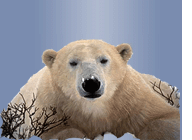
Polar Bear (Ursus maritimus) is the largest
meat-eating hunter
known to Eskimos as Nanook (the great white bear of the North)
and to millions of other people
as the polar bear |
|
 |
Panda Bear
The existence of this puzzling animal was
first revealed in 1869 by French Pere Jean Pierre Armand David.
He send back to Paris description about a new species that he named Ursus melanoleucus. One year
later Alphonse Milne-Edwards named the species Ailuropoda melanoleuca
or black and white bear, known today as panda bear or Pandas. |
|
 |
Grizzly Bear
Grizzly Bear (Ursus arctos horribilis) is a subspecies of the brown bear living in North America.
Today, almost all living brown bears with exception of the Kodiak are usually called Grizzly bear.
|
|
 |
Black Bear
Black bear (Ursus americanus) is a robbery animal species
from the family of the bears (Ursidae), living in North America.
In its homeland it is mostly called as black bear or Baribal.
In contrast to the rather feared Grizzly the black bear applies as harmless. |
|
 |
Biggest Bear
Kodiak bear (Ursus arctos middendorffi), sometime called Big Bear or Big Brown,
is the largest of all the brown bears. With the size that exceeds 3 meter it
is the largest terrestrial carnivore. |
|
 |
Brown Bear
As with American black bear, brown bears (Ursus arctos) have been the subject of
considerable taxonomic 'splitting' into subscpecies, the 'grizzly' and
the kodiak are probably the best known. |
|
 |
Sloth Bear
Sloth bear (Ursus ursinus) are small and black, sporting a long,
shaggy coat; the presence of brown and gey hairs in the coat may give
the appearance of a tawny or cinamon colouration.
In he past this bear has been extensively hunted due to
its reputation for aggression and drop destruction. Today sloth bear is suffering through
habitat loss due to a number of agricultural and development schemes. |
|
 |
Sun Bear
Sun bear (Ursus malayanus) is the smallest of the bears,
standing only 70cm at the shoulder and measuring 1.2 - 1.5m from nose
to rump. In the wild this bear is often cited as one of the most dangerous animals of
its range. |
|
 |
Spectacled Bear
Spectacled bear (Tremarctos ornatus) is the only
bear species to be found in South America, where is restricted to
the mountainous regions of Peru, Ecuador, Columbia and Venezuela.
Persecution and habitat loss due to human encroachment have led to a
decline in the range of this bear. In Peru spectacled bear is hunted for its meat and fur,
and population fragmentation, resulting in the isolation of individuals,
has become a severe threat to their reproductive success. |
|
 |
Asiatic black bear
Asiatic black bear (Ursus thibetanus) is medium-sized and usually uniformly black,
except for its light-coloured muzzle and a distinctive white chevron extending out
to the shoulders from the chest. In some areas, individuals, may appear to have a
more brown coloration. The ears appear large in proportion to the rest
of the head. The Asiatic black bear is suffering from the encroachment
of human activities into its habitat. |
|
 |
Red Panda Bear
Red Panda (Ailurus fulgens) is not bear. Calling them Red Panda Bear or Red Panda Bears is improper.
A long debate ensued as to whether or not Red Pandas were in fact bears, in the same manner as the
Giant Panda. However, it was determined that both Red Pandas and raccoons were related;
however they were not related to the Giant Panda. This became evidenced after studying the DNA of
Giant Pandas and comparing them with the DNA of Red Pandas. |
|
 |
Raccoon
Raccoon (Procyon lotor) is classified as a Procyonidae.
They are also members of the Carnivora group and are distinguished by their small size and the fact that
they are omnivorous, meaning that they eat both plants and meat. However, raccoons are known for
eating anything that they can get their highly adapted claws on. This is one main difference
between raccoons and bears, and has helped determine its classification as separate from Panda bears.
|
|
 |
Koala bear
Koala bear (Phascolarctos cinereus) comes from Australia
and is not a bear but like its Australian counterpart the
Kangaroo is in fact a marsupial. Koala bears are native to Australia and
extremely cute but the only reason the Koala is referred to
as "koala bears" is because it resembles the adorable little teddy bears
that are known for being cute and cuddly. |
|
 |
Teddy Bears
Teddy Bear have an universal appeal and
he is just 105 years old.
We can't even imagine a world without our favor toys - Teddy Bear.
Teddies are manufactured in many countries but all Teddy Bears
are messengers of love. |
|
Biological Classifications Bear Facts

- Name: The Bear
- Kingdom: Animalia
- Phylum: Chordata
- Subphylum: Vertebrata
- Class: Mammalia
- Subclass: Theria
- Order: Carnivora
- Suborder: Caniformia
- Family: Ursidae
- Superfamily: Ursoidea
|
|
|


